 listicle
5 Best Booking Platforms for Holiday Lets
Table of Contents
- Quick Comparison: Booking Platforms for Holiday Lets
- Airbnb: Global Reach and Brand Recognition
- Booking.com: The Established Multi-Channel Player
- Vrbo: Family Holiday Rentals and Longer Stays
- Houfy: Direct Bookings for Holiday Lets
- Sykes Holiday Cottages: Specialist UK Holiday Let Platform
- Holiday Let Management Software and Listing Optimisation
- Which Platform Should You Choose?
- Frequently Asked Questions
Last Updated: October 13, 2026
Quick Comparison: Booking Platforms for Holiday Lets
Choosing a booking platform means weighing global reach against direct control, commission costs against booking volume, and ease of use against advanced features. The 5 best booking platforms for holiday lets each offer different strengths and real trade-offs.

Most owners list on multiple platforms to maximise visibility, but managing calendars, pricing, and guest communication across five systems becomes a logistical nightmare. The best approach pairs platforms that reach your target guests with software that synchronises everything automatically.
This guide breaks down the five platforms that matter most, what they cost, and how to choose, plus the channel management tools that tie everything together.
| Platform | Best For | Key Strength | Main Trade-off |
|---|---|---|---|
| Airbnb | Unique, distinctive properties | Global reach and brand recognition | Higher commission rates |
| Booking.com | Established holiday lets | Trusted by international travellers | Less control over pricing |
| Vrbo | Family holidays and longer stays | Larger property inventory reach | Competitive commission structure |
| Houfy | Direct bookings and control | No platform service fee | Smaller audience than major platforms |
| Sykes Holiday Cottages | UK and Ireland properties | Specialist UK market focus | Limited international reach |
Airbnb: Global Reach and Brand Recognition
Airbnb dominates holiday rental search globally. If your property has distinctive character, a converted barn, a beachfront cottage, or a quirky design, Airbnb's audience actively searches for exactly that. The platform's strength is discovery: guests browse by experience and aesthetic, not just location and price.
Airbnb takes a cut from both you and the guest. Host fees typically range from 3% to 5% depending on cancellation policy and booking frequency, plus guests pay a service fee. On a £500 booking you might net £450.
What works for Airbnb: the platform favours strong visual presentation. High-quality photos directly influence search ranking and click-through rates, so professional photography is the difference between appearing in search results or being buried.
Where Airbnb falls short: limited pricing flexibility. The platform discourages frequent price changes and penalises aggressive rate adjustments, so testing pricing strategies or reacting to local events is frustrating. Calendar management also lags dedicated property management software, requiring third-party tools to sync with other platforms.
Booking.com: The Established Multi-Channel Player
Booking.com reaches international travellers at the moment they're actively searching and ready to book. Its core audience, leisure travellers, families, and business visitors, trusts an established brand and wants straightforward filtering by price, location, and amenities.
Booking.com's advantage is reach combined with trust. Decades of brand weight, especially in Europe, mean guests often start their search there, giving your property visibility without relying on algorithm tweaks or constant optimisation.
The trade-off: Booking.com controls pricing more aggressively than Airbnb, using dynamic pricing recommendations and sometimes penalising hosts who undercut suggested rates on other channels. You also have less control over listing presentation, as the platform dictates layout and photo positioning more strictly.
What most guides miss: Booking.com's strength isn't just reach but its guest quality filter. The review system and guest verification process attract more serious, lower-risk bookings, so you'll see fewer last-minute cancellations and problematic guests.
Vrbo: Family Holiday Rentals and Longer Stays
Vrbo (Vacation Rental by Owner) specialises in longer stays and family holidays. Its audience searches for entire homes, not rooms or shared spaces, and often books week-long or month-long periods. If your holiday let suits families or groups wanting extended stays, Vrbo delivers that audience reliably.
Vrbo's commission structure is more transparent than some competitors: it charges guests a service fee (typically 5-15% depending on booking length) rather than taking a cut from your nightly rate, so your pricing stays consistent throughout the booking process.
Where Vrbo excels: its filtering and search logic favour properties suitable for groups and families, giving amenities like kitchens, multiple bedrooms, and outdoor space prominent placement.
The limitation: Vrbo's global reach is smaller than Airbnb or Booking.com. You'll attract fewer spontaneous bookings from casual browsers. The platform works best as part of a multi-channel strategy, not as your sole listing channel.
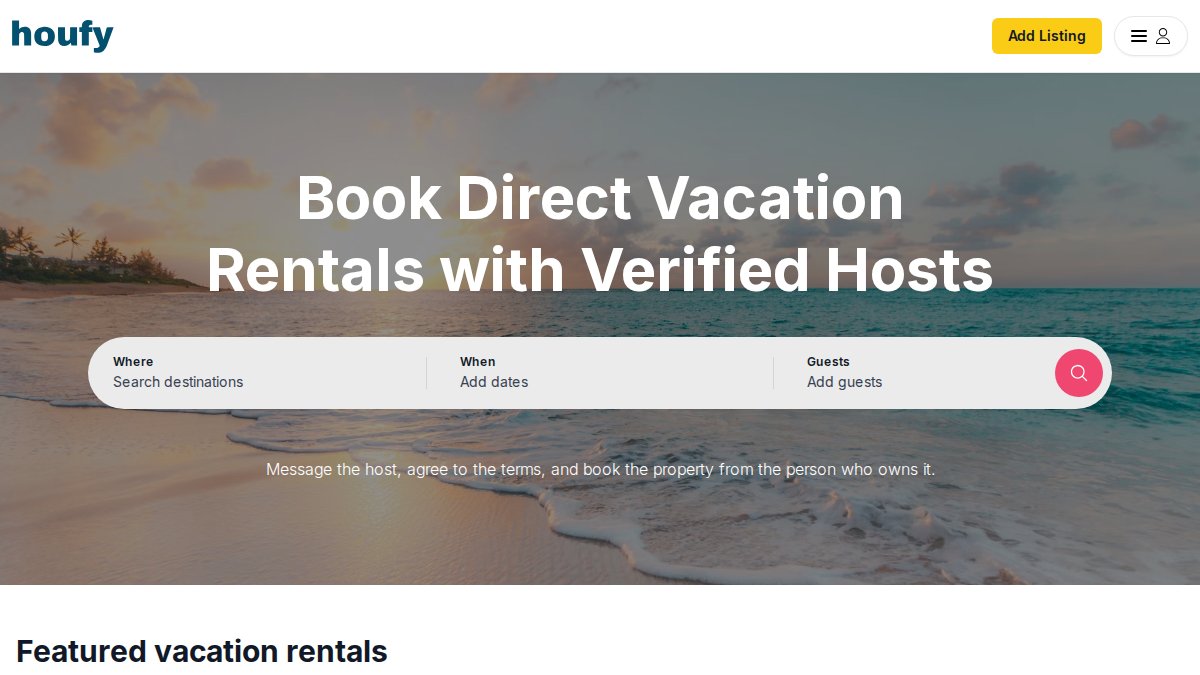
Houfy: Direct Bookings for Holiday Lets
Houfy takes a different approach: a direct-booking platform where guests find your property and book with you directly rather than through a middleman marketplace.
This matters financially. On a £500 booking you keep £500, no platform cut, no negotiation. For hosts managing multiple properties or running at scale, that compounds into significant savings.
The catch: Houfy's audience is smaller than Airbnb, Booking.com, or Vrbo. You rely on direct traffic, search engine visibility, and your own marketing, since the platform lacks the algorithmic discovery and brand recognition that bring casual browsers.
What works: Houfy suits hosts with an existing marketing strategy or guest relationships.
Where it struggles: new properties or hosts without existing visibility. Houfy doesn't replace marketing; it removes the middleman once you've driven traffic. You'll need professional photography, strong SEO, and possibly paid advertising to generate bookings.
Sykes Holiday Cottages: Specialist UK Holiday Let Platform
Sykes Holiday Cottages is a curated marketplace specifically for UK and Ireland holiday properties, focused exclusively on leisure holiday bookings rather than short-term rentals or business travel. That specialisation is both a strength and a limitation.
Sykes reaches UK and international guests specifically looking for holiday cottages and rural properties.
The advantage: Sykes vets properties before listing, so your competition is pre-filtered for quality. Guests expect professional, well-maintained holiday homes, meaning your property competes on merit rather than algorithm or marketing spend.
The limitation: Sykes's reach is regional. You'll get UK and European bookings but limited visibility in North America, Asia, or other distant markets. That's fine for domestic or European holiday-makers, but Sykes alone won't deliver global reach.
Commission and fees on Sykes vary by agreement, so contact the platform directly for current rates. The platform typically works best as part of a multi-channel strategy rather than your sole listing channel.
Holiday Let Management Software and Listing Optimisation
Managing listings across multiple platforms manually is inefficient and error-prone. Calendar synchronisation, pricing updates, and guest communication fragment across five systems, creating double bookings, missed messages, and wasted time.
Holiday let management software solves this by centralising operations: it synchronises availability across all platforms automatically, updates pricing from a single dashboard, and consolidates guest messages into one inbox. The best tools also handle guest screening, automated messaging, and basic reporting.
Common options include Guesty, OwnerRez, Hostfully, and Lodgify, each with tiered pricing based on portfolio size. Costs typically range from £20 to £100+ per month depending on features and scale, but the time savings and booking accuracy often justify the investment.
Channel Management and Avoiding Double Bookings
Double bookings are the operational nightmare of multi-channel hosting: you accept a booking on Airbnb, your calendar hasn't synced with Booking.com, and a guest books the same dates there. Now you're cancelling a booking, disappointing a guest, and damaging your reputation.
Channel management software prevents this by synchronising calendars in real-time: accepting a booking on any platform immediately blocks those dates across all your listings. It also pulls guest information, pricing, and cancellation policies into a central system, so you're not switching between five interfaces.
Most management software also automates guest communication, sending check-in instructions, house rules, and check-out reminders from templates you control, improving guest experience and reducing support burden.
The trade-off: management software adds a monthly cost and a small learning curve. For hosts with one or two properties on one or two platforms, the overhead may outweigh the benefit. For anyone listing on three or more platforms, it's essential.
Building Your Multi-Channel Strategy
The strongest strategy combines platforms strategically rather than listing everywhere. Start by identifying where your target guests search.
If you're marketing a family cottage for school holidays, prioritise Vrbo and Booking.com, whose audiences actively search for family properties. Add Sykes Holiday Cottages if you're in the UK or Ireland. Airbnb can supplement, but it's not your core channel.
If you're marketing a distinctive or experiential property, a converted barn, a luxury villa, a beachfront cottage, Airbnb should be your primary channel. Supplement with Booking.com and Vrbo for broader reach.
If you're confident in your marketing and have existing guest relationships, Houfy captures direct bookings without commission overhead, but it shouldn't be your only channel unless you're already established.
Most successful hosts list on two to three major platforms and use management software to handle operations, balancing reach with manageability.
Which Platform Should You Choose?
Your choice depends on three factors: property type, target audience, and operational capacity.
For distinctive or experiential properties: Start with Airbnb, which rewards unique properties with strong visual presentation.
For family holidays and longer stays: Prioritise Vrbo and Booking.com, whose audiences actively search for full homes and extended bookings.
For UK and Ireland holiday properties: Include Sykes Holiday Cottages, which reaches a highly qualified local audience. Combine with Booking.com or Vrbo for international reach.
For maximum control and no commission: Use Houfy, but only with existing marketing channels or guest relationships.
For operational simplicity: Choose two or three platforms maximum and use management software to synchronise them. Listing on five platforms without automation creates more problems than it solves.
The critical factor across all platforms: professional photography. High-quality images that show layout, lighting, and finish directly increase booking rates on every platform.
Property Home Photos provides professional property photography that captures your holiday let at its best.
The right booking platform strategy balances reach with control: access to guests actively searching for holiday lets, without drowning in administrative overhead. Start with platforms that match your property type and audience, use management software to keep calendars and pricing synchronised, and invest in professional photography to maximise conversion on every platform. Request a quote from Property Home Photos to see how professional property photography can support your marketing goals across all your listing channels.
Frequently Asked Questions
What is the difference between Airbnb, Booking.com and Vrbo for holiday let hosts?
Airbnb emphasises unique stays and attracts younger, experience-focused guests. Booking.com is the world's largest online travel agency with broad appeal to families and business travellers. Vrbo specialises in larger family homes and longer stays. All three charge commission on bookings, but their fee structures, guest demographics, and marketing reach differ. Your choice depends on your property type, target guest, and preferred commission model.
Can holiday let owners take direct bookings without using a platform?
Yes. Direct bookings allow you to avoid platform commissions entirely. Platforms like Houfy facilitate direct contact between hosts and guests, while others such as Lodgify provide templates to build your own direct-booking website. Direct bookings require you to handle marketing, guest communication, and payment processing independently, but they offer greater control over pricing and cancellation policies.
How can I increase holiday let bookings across multiple platforms?
List on multiple channels simultaneously to expand your reach. Use holiday let management software to synchronise availability across platforms, preventing double bookings. Optimise your listing with professional photography, clear descriptions, and competitive pricing. Respond quickly to guest enquiries and maintain positive reviews. Consider a mix of major platforms (Airbnb, Booking.com) and specialist channels (Sykes for UK properties) based on your target market and property type.
Do I need to pay commission on every booking through these platforms?
Most platforms charge commission on bookings, typically between 10% and 20% of the reservation value. Houfy claims no platform service fee, though other costs may apply. Direct-booking platforms and your own website eliminate platform commissions but require you to handle marketing and guest acquisition yourself. Compare total costs, including commission, against the booking volume each platform generates for your property.