 ultimate-guide
Professional Real Estate Video Services: 2026 Guide
Table of Contents
- Why Professional Real Estate Video Services Win More Enquiries
- Types of Property Video: Walkthroughs, Cinematic Films, and Aerial Drone Capture
- Property Walkthrough Video Length: What Actually Works
- Real Estate Video Production Best Practices
- Social Media, CRM Integration, and Where Your Video Gets Used
- Property Videography Pricing: What Shapes the Cost
- Legal Requirements and Compliance for Property Video
- Frequently Asked Questions
Last Updated: August 31, 2026
Why Professional Real Estate Video Services Win More Enquiries
Property listings with video attract significantly more enquiries than those relying on photographs alone. Video communicates what photographs cannot: scale, flow, natural light, and the feeling of moving through a space. A buyer watching a walkthrough understands the relationship between rooms in thirty seconds, understanding that might take minutes from photographs alone, or never arrive at all.
Professional real estate video also builds trust before a viewing. When a listing presents 4K broadcast quality footage with smooth gimbal stabilisation and accurate colour grading, it signals that the vendor takes the property seriously. Listings with video tend to generate more qualified enquiries, meaning fewer wasted viewings. Buyers who have watched a cinematic walkthrough already know the layout, finish, and proportions before arriving.
According to Rightmove's property marketing guidance, listings that include video content receive higher engagement rates than those without. For estate agents managing multiple listings, that engagement difference compounds into a measurable advantage over a sales quarter.
Below, we cover every format of property video, what production involves, how to think about pricing, and the legal requirements that many agents overlook.
Types of Property Video: Walkthroughs, Cinematic Films, and Aerial Drone Capture
Three distinct formats dominate professional real estate video production, each serving a different purpose.
Walkthrough Videos
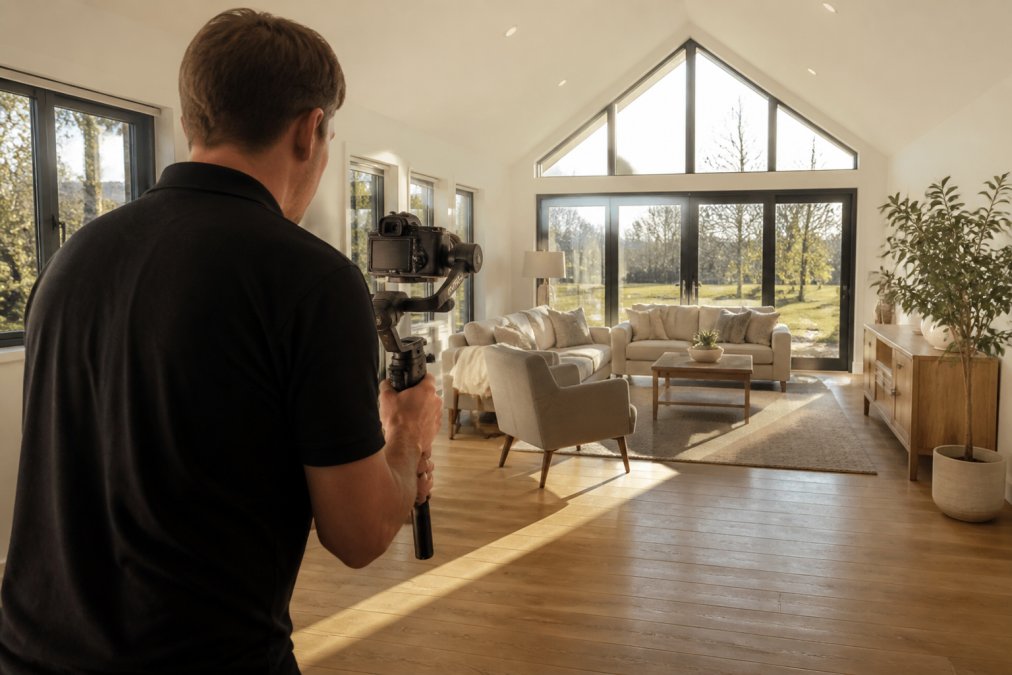
A walkthrough video is the workhorse of property marketing. It moves through the property room by room, mimicking a guided viewing. Shot on a gimbal with a wide-angle lens, a good walkthrough captures spatial flow, ceiling height, and the connection between indoor and outdoor areas. The key technical requirements are stabilisation, wide-angle coverage, and clean lighting. Shaky footage or poorly lit rooms will damage the listing more than no video at all.
Cinematic and Promotional Films
Cinematic property films use visual storytelling to create an emotional response through slow camera movements, composed shots, colour grading, and licensed music. This format suits luxury residential properties, new-build developments, and commercial spaces where brand identity matters. The production investment is higher, but so is the impact. Cinematic films are digital assets that get shared, embedded on developer websites, and used in broader marketing campaigns.
Aerial Drone Footage
Aerial drone capture adds context that no ground-based camera can replicate. For properties with significant land, coastal or countryside settings, or impressive architecture, drone footage transforms the listing. A buyer watching aerial footage understands the property's relationship to its surroundings, garden size, and local area. Drone footage is also most likely to be shared on social media, where dramatic visual content drives engagement beyond the immediate listing.
Property Walkthrough Video Length: What Actually Works
The ideal property walkthrough video length is 60 to 90 seconds for most residential listings. This duration covers key rooms, communicates flow, and holds viewer attention without fatigue.
| Property Type | Recommended Length | Platform Context |
|---|---|---|
| Studio or one-bed flat | 30-45 seconds | Portals and social Reels |
| Two to three-bed house | 60-90 seconds | Portals and website |
| Large family home | 90-120 seconds | Website and email campaigns |
| Luxury or development | 2-3 minutes | Developer site and campaigns |
| Commercial property | 90-120 seconds | Direct to tenants and agents |
| Holiday let | 60-90 seconds | Booking platforms and social |
The biggest mistake is padding. A 3-minute video of a two-bedroom flat does not communicate more value; it signals poor editing decisions. For social media, shorter is better. Instagram Reels and TikTok reward content under 60 seconds, and a 30-second cut will outperform a 2-minute unedited tour.
Real Estate Video Production Best Practices
Real estate video production quality is decided before a single frame is captured. Planning, staging, and equipment choices determine what post-production can achieve.
Equipment: 4K Cameras, Gimbals, and Lighting
The baseline for professional property video is 4K broadcast quality footage. Below that resolution, images lose crispness on modern screens. The gimbal is equally important, smooth, stabilised movement separates professional footage from phone video. Motorised gimbals eliminate shake during walkthrough sequences, allowing fluid transitions that feel natural.
Lighting techniques complete the picture. Natural light is the starting point, with shoots planned around time of day and weather. Supplementary lighting fills shadows in darker rooms and ensures consistent exposure. Poor lighting is the single most common technical failure in property video. Wide-angle lenses are standard for interior work and communicate space accurately.
Post-Production: Colour Grading and Video Editing
Post-production is where a competent shoot becomes compelling. Video editing assembles footage into a logical, engaging sequence. Colour grading adjusts the tonal palette to feel warm, inviting, and accurate. A common mistake is over-processing, footage that looks dramatically different from the property's actual appearance creates trust problems. The standard to aim for is footage that looks like the best version of the property, not a different property entirely.
DIY vs. Professional: An Honest Comparison
DIY property video is rarely competitive with professional work. The technical barriers are real: stabilisation, lighting, colour grading, and editing are skills that take time to develop.
For properties at the lower end of the market, the cost calculation may not stack up. For anything mid-market and above, the enquiry uplift from professional video typically justifies the cost within the first additional viewing it generates.
Social Media, CRM Integration, and Where Your Video Gets Used
Producing a property video is only half the job. Distribution determines its actual return. The primary channels are property portals, the agent's website, and social media. Portals like Rightmove and Zoopla support embeddable content directly on listings, where videos earn most views from buyers already in a buying mindset.
Social media Reels extend reach to audiences not actively searching for property. A well-shot cinematic film or aerial sequence can generate shares that no portal listing achieves, particularly valuable for new-build developments and holiday lets.
CRM integration is underused. When video is hosted on platforms supporting embeddable content and tracking, it becomes a lead generation asset. Links can be sent to registered buyers, included in email campaigns, and embedded in brochures. Tracking engagement tells agents which buyers are most interested.
Property Videography Pricing: What Shapes the Cost
Property videography pricing varies considerably. Primary variables are:
- Property size and complexity: More rooms require more time on site and more footage to edit.
- Video format: A basic walkthrough costs less than a cinematic film with drone footage, licensed music, and colour grading.
- Turnaround time: Faster delivery typically commands a premium.
- Location and travel: Providers further away factor travel time into quotes.
- Combined packages: Photography and video booked together often receive discounted rates.
What shapes value is enquiry uplift. A professional real estate video that generates two additional viewings has already returned its cost many times over in agent time saved and sale speed gained. According to RICS guidance on property marketing and valuation, presentation quality has measurable influence on perceived value and time to sale.
Legal Requirements and Compliance for Property Video
Legal compliance in property video is an area where many agents are under-informed.
Drone footage regulation is most significant. Commercial drone operations in the UK are regulated by the Civil Aviation Authority under the Air Navigation Order 2016. Operators filming commercially must hold a General Visual Line of Sight Certificate (GVC) and register with the CAA. Drones must not be flown within 50 metres of people, vehicles, or structures not under the operator's control. As documented in Civil Aviation Authority drone rules for commercial operators, any videographer offering commercial aerial footage must demonstrate valid CAA registration and appropriate operator certification.
Consumer protection law applies directly to property marketing. Under the Consumer Protection from Unfair Trading Regulations 2008, misleading visual representations of a property are unlawful. Footage that significantly misrepresents size, condition, or features creates legal exposure.
Music licensing is a compliance issue many property videos fail on. Using commercially released music without a licence is copyright infringement. Professional videographers source licence-free music or hold appropriate commercial licences.
Data protection applies where footage captures neighbouring properties, public spaces, or identifiable individuals. Under UK GDPR, personal data captured incidentally should be handled appropriately and not published without consideration of third-party privacy.
Professional property video is no longer a premium add-on for high-value listings, it is the baseline expectation for any property marketed seriously. Property Home Photos works directly with photographer Mark Henry Rood, with a satisfaction guarantee and turnaround times built around your schedule. Request a quote and get a property showcase that generates the enquiries your listing deserves.
Frequently Asked Questions
What are the benefits of using professional real estate video services for property listings?
Professional real estate video services give prospective buyers, tenants, and guests a clear sense of layout, finish, and atmosphere before they visit. Listings with high-definition video consistently attract higher engagement rates than those with photos alone. For estate agents and holiday let owners, that translates into more enquiries, faster decision-making, and fewer wasted viewings. Cinematic production, colour grading, and stabilised footage also signal credibility, which builds trust before anyone sets foot through the door.
How long should a professional real estate property video be?
For most residential listings, a walkthrough video of 60 to 90 seconds performs best on property portals and social media. Short-form Reels or highlight clips of 30 to 45 seconds suit Instagram and TikTok. Larger or more complex properties, such as commercial spaces or luxury homes, can justify a two to three minute promotional film. Going beyond three minutes risks losing viewer attention unless the property genuinely warrants a full cinematic showcase.
What is the difference between a property walkthrough and a promotional video?
A walkthrough video guides viewers through each room in sequence, prioritising layout clarity and spatial understanding. It is practical and information-led. A promotional or cinematic video uses visual storytelling, carefully chosen angles, music, colour grading, and sometimes aerial drone capture to create an emotional response. Walkthroughs suit buyers who want facts; promotional films suit marketing campaigns where brand identity and aesthetic appeal are the priority. Many professional real estate video services offer both formats.
Do professional real estate video services include aerial drone footage?
Many providers offer aerial drone capture as part of higher-tier packages or as an add-on. Drone footage is particularly effective for properties with substantial grounds, coastal or countryside settings, and commercial developments where context and location matter. Any drone operator filming commercially must hold a valid General Visual Line of Sight Certificate (GVC) and ensure the flight complies with Civil Aviation Authority (CAA) regulations. Always confirm your provider's CAA authorisation before booking drone work.