 ultimate-guide
Hire Professional Real Estate Photographer: 2026 Guide
Table of Contents
- Why Professional Real Estate Photography Sells Property Faster
- What to Look For When You Hire Professional Real Estate Photographer
- What's Included in a Professional Property Photography Package
- Cost of Property Photography UK: What Affects Your Quote
- How to Prepare a Property for a Photoshoot: A Homeowner's Checklist
- Professional Real Estate Video Services and Other Add-Ons
- Legal and Licensing Rights for Property Images
- Conclusion: Choosing the Right Photographer for Your Property
- Frequently Asked Questions
Last Updated: September 29, 2026
Why Professional Real Estate Photography Sells Property Faster
Professional real estate photography uses specialist equipment, trained composition, and post-production editing to represent a property accurately and attractively. When you hire professional real estate photographer services, you get images that don't just document a space, they sell it.
What to Look For When You Hire Professional Real Estate Photographer
The right photographer specialises in property, not a generalist who occasionally shoots houses. Property photography has its own demands: wide-angle interiors, mixed lighting, and tight turnaround expectations.
Portfolio and Style Checks
Look for a portfolio with a consistent style across interiors and exteriors, not one lucky shot, and check whether images look natural or over-processed. A strong portfolio should show:
- Consistent colour and exposure across every room
- Straight verticals (no leaning walls or tilted doorframes)
- A mix of wide establishing shots and detail shots
- Examples of both daylight and twilight exterior photography
Equipment and Editing Standards
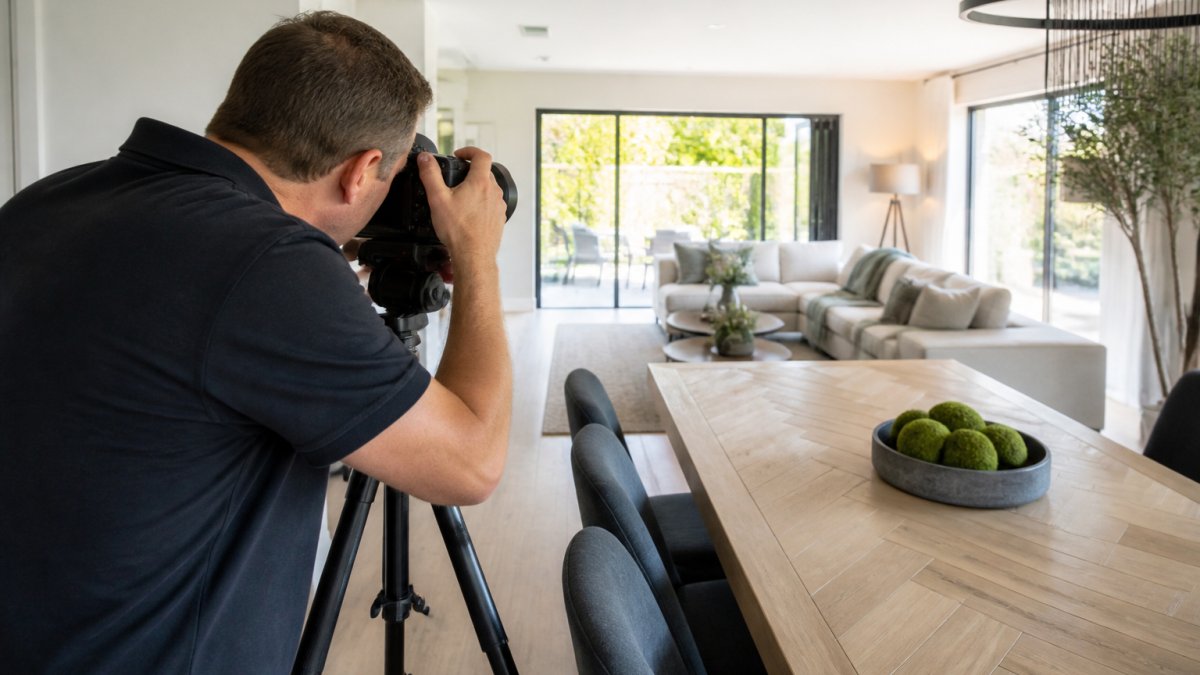
A professional property photographer should use a full-frame or high-quality crop-sensor camera, a wide-angle lens in the 16-24mm equivalent range, and a sturdy tripod. Bracketing and HDR processing are standard for handling contrast between bright windows and darker interiors.
What's Included in a Professional Property Photography Package
Most professional packages cover a defined number of edited images, a delivery timeframe, and a marketing licence. The gap between a cheap package and a thorough one is rarely the number of photos, it's what happens before and after the shutter clicks.
A typical package structure looks like this:
| Package Element | What It Usually Covers | Why It Matters |
|---|---|---|
| Edited stills | 15-30 high-resolution images | Core listing assets |
| Interior and exterior shots | Every room plus front and rear | Full property context |
| Floor plan | 2D measured plan | Helps buyers understand layout |
| Turnaround time | 24-72 hours for edited delivery | Protects your launch date |
| Image licensing | Marketing use rights | Prevents legal issues later |
What Actually Drives the Scope
Three things determine shoot length and image count:
- Room count, not floor area. A four-bedroom house with a study, utility room and two bathrooms takes longer than a larger open-plan flat. Photographers price on distinct spaces needing lighting and framing, not square metres.
- Lighting complexity. A south-facing new-build with large glazing needs bracketing and HDR blending to hold window detail; a period property with small windows and dark hallways needs supplementary flash or continuous lighting, adding setup time per room.
- Dressing and staging. Empty rooms photograph poorly, they read as small and echoey.
Floor Plans, Virtual Tours and Video
These add-ons are often mis-sold as "included". Ask specifically:
- Floor plans, a measured 2D plan drawn on site, or a rough sketch traced from an agent plan? Measured plans take 20-40 minutes extra and are the ones buyers and portals trust.
- Virtual tours, 360-degree tours need a separate camera and hosting platform. Check whether the hosting fee is one-off or an annual subscription, because that cost recurs.
- Video, a walkthrough video is a distinct shoot with its own edit. A 60-second social cut and a 2-3 minute full walkthrough are different deliverables; confirm which you get.
Questions to Ask Before You Book
- How many edited images are included, and what is the cost per additional image?
- Is the floor plan measured on site or supplied separately?
- Does the licence cover portals, your own site, and social media, and for how long?
- What is the delivery window, and is it working days or calendar days?
- Are travel costs included within a set radius, and what is charged beyond it?
For commercial photography, scope is negotiated around the size of the space and how many distinct areas need covering. A retail unit, a restaurant with a bar and dining area, and a multi-floor office each carry different time requirements, so a per-room or per-area quote is more honest than a flat fee.
Cost of Property Photography UK: What Affects Your Quote
The cost of property photography depends on several variables, not a single flat rate: property size, number of images, travel distance, turnaround speed, and add-ons like video, drone, or floor plans. Rather than quote one figure, it helps to understand the bands most photographers work within and what pushes a job between them.
Indicative Price Bands
These are the ranges most commonly seen across the market. Treat them as a budgeting guide, not fixed prices, every property is different.
| Scope | Typical Range (excl. VAT) | What Sits at This Level |
|---|---|---|
| Compact flat or studio | Lower band | 10-15 edited stills, one location, standard turnaround |
| Standard 2-3 bed home | Mid band | 20-30 edited stills, interior and exterior, floor plan often included |
| Larger home or 4+ bed | Upper band | 30+ stills, multiple floors, twilight or drone add-ons common |
| Commercial or hospitality venue | Quoted per site | Multiple areas, dressed shoot, video or virtual tour likely |
The Factors That Move a Quote Most
- Property size and type, a studio flat needs far less time than a six-bedroom house or multi-floor commercial unit. Room count matters more than floor area.
- Number of deliverable images, more edited images means more post-production time; extras are usually charged individually beyond the package allowance.
- Add-on services, aerial photography, video, and virtual tours add scope. Drone work carries its own regulatory and insurance overhead, reflected in the price.
- Turnaround requirements, urgent delivery carries a premium. A 24-hour turnaround costs more than a 72-hour one because it jumps the editing queue.
- Travel and access, remote locations or restricted access add cost. Parking restrictions, gated access, and permits can all extend on-site time.
- VAT, most established photographers are VAT-registered, so always confirm whether a quote is inclusive or exclusive. A £300 quote plus VAT is £360.
Why Blind Quotes Are a Warning Sign
Because pricing is genuinely bespoke, no credible photographer quotes blind. A property with awkward lighting, a long drive, or tight access takes longer than a straightforward one, and a photographer who quotes without asking is either guessing or planning to cut corners.
Getting an Accurate Quote
To get a comparable quote, have the following ready before you enquire:
- Property type and number of rooms to be photographed
- Whether the property is furnished, vacant, or needs virtual staging
- Which add-ons you want (floor plan, video, drone, twilight, virtual tour)
- Your required delivery date
- The full address, so travel can be calculated
How to Prepare a Property for a Photoshoot: A Homeowner's Checklist
Preparing a property properly before the shoot is the difference between good images and great ones. The photographer controls the camera; you control what's in front of it.
Declutter and Depersonalise
Remove personal items that distract from the space. Family photos, fridge magnets, bins, and bathroom clutter all pull attention away from the room itself.
- Clear all worktops and surfaces of non-essential items
- Remove personal photos, cards, and children's artwork
- Tuck away bins, cleaning products, and pet items
- Straighten cushions, throws, and bedding
- Hide cables and chargers
- Store toiletries out of sight in bathrooms
Lighting and Time of Day
Turn on lamps and overhead lights to supplement natural light, and open all curtains and blinds. Daylight photography works best mid-morning or early afternoon when light is even. Twilight photography, shot just after sunset, is particularly effective for exteriors and hospitality venues because it shows a property at its most inviting.
Professional Real Estate Video Services and Other Add-Ons
Professional real estate video services extend a stills package into walkthrough video, increasingly expected on higher-value listings and holiday lets. Video lets viewers experience the flow between rooms in a way stills can't, and it's especially valuable for hospitality venues where atmosphere sells.
Beyond video, common add-ons include:
- Aerial photography and drone services - useful for showing land, grounds, or a property's position relative to surroundings
- Twilight photography - exterior shots taken at dusk
- Floor plans - measured 2D layouts
- Virtual tours - 360-degree interactive walkthroughs
Legal and Licensing Rights for Property Images
Image licensing determines how, where, and for how long you can use the photographs delivered. It's the area most clients overlook, and it causes real problems later.
- Who owns the copyright (usually the photographer)
- What the licence permits and for how long
- Whether sub-licensing to agents or portals is included
- What happens to the images if the property is relisted
Conclusion: Choosing the Right Photographer for Your Property
The gap between an average listing and a compelling one usually comes down to the images. When you hire professional real estate photographer services, you're buying more than pictures: the first impression that determines whether someone clicks, books a viewing, or scrolls past.
Frequently Asked Questions
How much does a property photographer charge?
Pricing depends on the size of the property, the number of images, travel distance, and whether you add video or drone services. Most photographers offer packages rather than a flat hourly rate. For an accurate figure tailored to your property, request a quote from Property Home Photos. They will assess your needs and provide a clear price before you commit.
What should I look for in a professional real estate photographer's portfolio?
Look for consistent lighting, straight vertical lines, accurate colour, and a mix of wide-angle interior and exterior shots. A strong portfolio should show properties similar to yours and demonstrate experience with different lighting conditions, including twilight photography. Check that images look natural and not overly edited.
How long does a professional property photoshoot take?
Most residential shoots take between one and two hours, depending on property size and the number of setups. Larger homes, commercial spaces, or shoots that include video and drone work can take three hours or more. A professional photographer will plan the schedule to minimise disruption, especially for holiday lets and hospitality venues with guests on site.
Do I need a video service alongside my property photos?
Video is increasingly valuable for holiday lets, hospitality venues, and higher-value homes. A short promotional video can showcase atmosphere, flow, and unique features that stills cannot capture. It also performs well on social media and property portals. If your budget allows, combining professional real estate video services with still photography gives you a complete marketing package that appeals to different audiences.