 listicle
Commercial Property Photography Pricing Guide 2026
Table of Contents
- What Drives Commercial Property Photography Pricing
- Commercial Property Photography Day Rate vs Per Image
- What a Typical Commercial Photography Package Includes
- Professional Real Estate Video Services and Add-On Pricing
- How to Prepare a Commercial Space for a Photoshoot
- Usage Rights, Licensing, and Contractual Hidden Costs
- How Professional Imagery Delivers ROI for Commercial Properties
- Conclusion
- Frequently Asked Questions
Last Updated: September 16, 2026
What Drives Commercial Property Photography Pricing
Commercial property photography pricing is the total cost of producing professional images of a commercial building or space, shaped by the size of the property, the scope of the shoot, and the amount of editing each image needs. At Property Home Photos, we build every quote around those three variables rather than a flat rate card, because a single retail unit and a 20,000 square metre distribution centre are not the same job.
Property Size and Project Scope
Property size sets the floor for any commercial shoot. More floor area means more setups, longer walking distances between shots, and more images to deliver. A small office suite might need 15 final images; a multi-floor building with meeting rooms, reception, and external elevations can need 60 or more.
Post-Production and Image Editing
Post-production is where commercial images separate from phone snapshots. The work covers colour correction, HDR processing, straightening verticals, and retouching. On commercial interiors, verticals must be true or the building looks like it is leaning.
Commercial Property Photography Day Rate vs Per Image
The day rate versus per-image decision comes down to how predictable the shoot is. A day rate charges for the photographer's time; per-image pricing charges for the finished assets. Most commercial work is quoted as a half-day or full-day rate plus a set number of edited images.
| Pricing Model | Best For | Main Risk | What to Agree Up Front |
|---|---|---|---|
| Day rate | Complex or multi-area commercial sites | Scope creep if deliverables are vague | Number of edited images included |
| Per-image | Small, defined shoots | Cost rises fast on large portfolios | Rate per image and editing level |
| Hybrid | Most commercial briefs | Needs a clear written schedule | Day rate plus image allowance |
| Licensing-based | Long campaigns, multi-channel use | Underpricing broad usage | Usage period, media, territory |
What a Typical Commercial Photography Package Includes
Most commercial packages include a pre-shoot call, a site visit or recce, the shoot itself, and a set number of edited, high-resolution images delivered digitally. What varies is how many images, how much retouching, and how long the client can use them.
Professional Real Estate Video Services and Add-On Pricing
| Add-on | Typical pricing basis | What drives the cost | What to confirm in writing |
|---|---|---|---|
| Drone photography and aerial imagery | Per flight session or per half-day, plus a set number of edited stills | Civil Aviation Authority permissions, operator certification, site location, weather contingency, and whether the site sits near restricted airspace | Whether the operator holds the necessary CAA permissions, who arranges them, and what happens if weather grounds the flight |
| Twilight shoot | Premium over the standard day rate, often a fixed uplift per property | The narrow window after sunset, the need for a second visit if the day shoot is separate, and additional lighting and blending work in edit | Whether twilight is bundled with the day shoot or charged as a second attendance |
| Virtual staging | Per image, with a discount for volume | Number of rooms staged, level of furnishing detail, and whether the client supplies reference styles | That the image is clearly labelled as virtually staged, and how long the staged files are licensed for |
| Floor plans | Per plan, banded by floor area | Whether the plan is drawn from a measured survey or from existing drawings, number of floors, and level of detail | Whether the plan is supplied as a 2D marketing plan, a 3D plan, or both |
| Additional edited images | Per image, above the package allowance | Editing level (standard correction versus advanced retouching) and turnaround | The per-image rate before the shoot, not after |
| Rush delivery | Percentage uplift on the total, or a fixed expedite fee | How far the deadline sits inside the standard turnaround, and whether editing capacity allows it | The exact delivery time you are buying, stated in hours or working days |
If your budget is fixed, the most common way to control it is to prioritise stills and floor plans, which do the heaviest lifting on listing portals, and treat video and drone as second-phase additions once the space is styled and occupied. That sequencing also avoids paying for aerial or video work on a site that is still full of contractor vans.
How to Prepare a Commercial Space for a Photoshoot
Preparation decides how much of the shoot day is spent photographing versus moving things. Clear desks, remove bins and cables, clean glass, and switch on every light. For retail and hospitality, style the space as it would look in service.
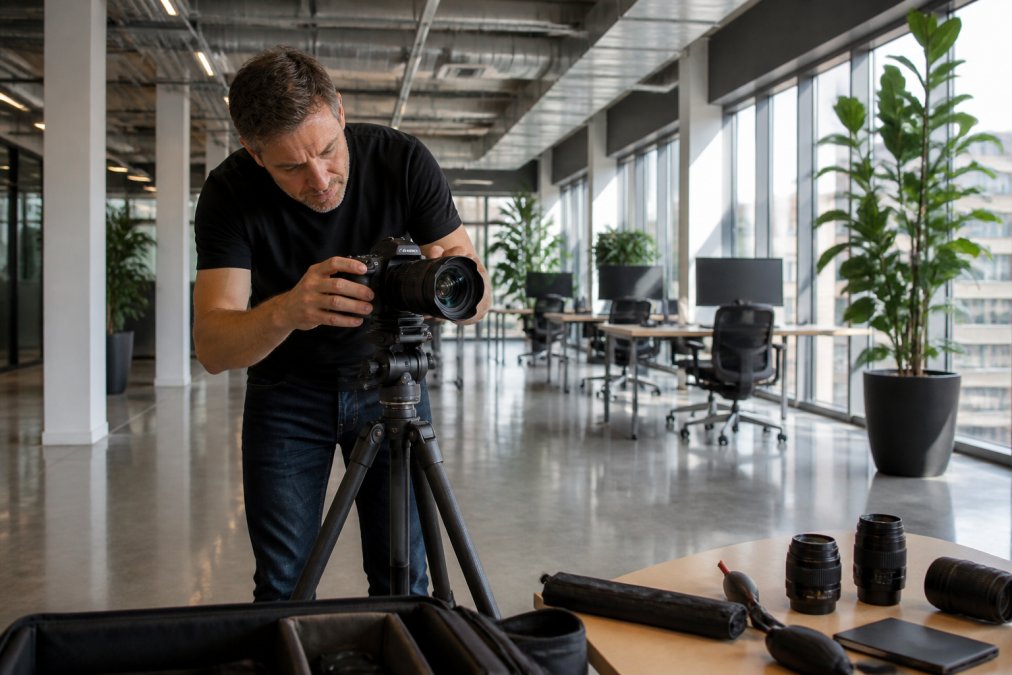
A short checklist before the photographer arrives:
- Declutter surfaces, desks, and reception areas
- Hide bins, cables, and cleaning equipment
- Clean windows, glass partitions, and mirrors
- Replace blown bulbs and test all lighting
- Confirm access, parking, and any building restrictions
- Book out-of-hours slots if the space is in daily use
Usage Rights, Licensing, and Contractual Hidden Costs
Usage rights and ownership are not the same thing, and conflating them is the most expensive mistake a commercial client can make. Under copyright law, the photographer or their studio typically owns the copyright in the images from the moment they are created. What the client buys is a licence, a permission to use those images within defined limits. A quote that looks cheap is often cheap because the licence is narrow, not because the photography is.
A commercial licence should answer five questions in writing:
- Media: where the images can appear, website, portal listings, print brochures, paid social, email, presentations, or all of them
- Territory: which countries the licence covers, which matters if you market a portfolio internationally
- Duration: how long the licence runs, and what happens at expiry
- Exclusivity: whether the photographer can license the same images to other parties, and whether they can use them in their own portfolio
- Sub-licensing: whether you can pass the images to agents, tenants, or a marketing agency working on your behalf
Contractual Hidden Costs to Look For
Hidden costs rarely appear as a surprise line on the invoice. They sit in the terms, and they surface later. The four that catch commercial clients most often are:
- Extended or renewed licensing. If the licence expires mid-campaign, you either stop using the images or pay to extend. Check the renewal fee and the notice period before you need them.
- Reshoots after the space changes. A unit that is re-fitted, re-let, or re-branded needs new images. Some agreements include a discounted reshoot rate within a set period; most do not.
- Travel and access fees. Photographers based outside your area may charge mileage or a travel day. Sites with restricted access, permit requirements, or security escorts can add time that is billed at the day rate.
- Cancellation and postponement terms. Commercial shoots are often cancelled because a lease completes early or a fit-out runs late. The cancellation window and the percentage charged inside it should be stated in the agreement, not negotiated after the fact.
- Rush-order surcharges. If your launch date moves forward, expedited editing is usually a percentage uplift. Knowing the uplift in advance lets you decide whether to pay it or move the date.
How Professional Imagery Delivers ROI for Commercial Properties
Return on investment for commercial imagery shows up as shorter void periods and fewer wasted viewings. Good images filter out mismatched enquiries before anyone travels to site, which saves an agent's time as much as it saves the tenant's.
Conclusion
The real risk in commercial property photography is not the fee, it is a shoot that misses your launch date or a licence that expires mid-campaign. Property Home Photos works directly with photographer Mark Henry Rood, plans turnaround around your listing dates, and backs every shoot with a satisfaction guarantee. Get started with Property Home Photos and give your commercial space imagery that wins the right enquiries.
Frequently Asked Questions
How much does commercial property photography cost?
There is no single figure because commercial property photography pricing depends on property size, location, the number of final images, and whether you need extras like drone photography or virtual staging. A small retail unit needs far less time than a multi-floor office block. Most photographers quote per project after discussing your brief. Request a tailored quote so the price reflects your exact requirements rather than a generic estimate.
Should I pay a day rate or per-image fee for commercial photography?
The commercial property photography day rate vs per image decision comes down to volume and control. A day rate suits larger projects where you want the photographer on site for several hours capturing multiple spaces, angles, and detail shots. Per-image pricing works well for smaller jobs where you know exactly how many final images you need. Ask your photographer which model fits your project scope before committing.
What is included in a standard commercial property photography package?
A standard package typically covers a pre-shoot consultation, the on-site photography session, professional image editing including colour correction and HDR processing, and delivery of high-resolution digital files. Some packages also include floor plans, twilight shots, or a set number of retouched images. Always confirm what is included in writing, especially around image licensing and turnaround time, so there are no surprises.
How do I prepare a commercial space for a photoshoot?
Declutter surfaces, remove personal items, clean windows and floors, and ensure all lighting works. For hospitality venues, style tables and bars to look inviting rather than empty. For offices, tidy desks and hide cables. If your space has a shopfront, clean the exterior and consider timing the shoot for good natural light. A short preparation checklist from your photographer makes this straightforward.
Can I get professional real estate video services alongside photography?
Yes. Many commercial projects benefit from combining still photography with professional real estate video services. Video walkthroughs help prospective tenants and buyers understand flow and scale in a way stills alone cannot, and they work well on listing platforms and social media. Ask your photographer whether they offer video as an add-on and how it affects turnaround time.