 blog
5 Best Practices for Property Listing Headlines
Table of Contents
- Why Property Listing Headlines Decide Whether Buyers Click
- Best Practice 1: Keep Headlines Concise and Straightforward
- Best Practice 2: Highlight the Benefits and Unique Features Buyers Care About
- Best Practice 3: Use Attention-Grabbing Language Without Overpromising
- Best Practice 4: Write for Search Intent and Include the Right Keywords
- Best Practice 5: Test Headline Performance and Refine Over Time
- Property Listing Headline Examples You Can Adapt
- Holiday Rental Listing Title Tips for Bookings
- Frequently Asked Questions
Last Updated: October 17, 2026
Why Property Listing Headlines Decide Whether Buyers Click
Most buyers never read past your headline. They scan a portal page, judge five or six titles in seconds, and tap only the ones that promise something worth their time. That makes the headline the hardest-working line in your whole listing.
A strong set of photos behind a weak headline gets ignored. A clear, specific headline pulls people into the gallery where the images can do their job.
So here are five best practices for property listing headlines, plus a repeatable formula, platform limits, and the compliance rules that catch agents out.
Best Practice 1: Keep Headlines Concise and Straightforward
Short headlines win because they are read at a glance, often on a phone. Aim for roughly 40 to 60 characters, or around six to ten words. Anything longer gets cut off or skimmed.
Straightforward beats clever. A buyer scanning a results page wants to know three things fast: what the property is, where it is, and what makes it stand out. Put those first.
- Lead with the property type and a defining feature
- Drop filler words like "beautiful" and "must see"
- Keep the location readable, not a full postal address
Platform-Specific Headline Limits to Work Within
Every portal and channel trims titles differently, so write for the tightest one first.
| Platform | Practical limit | What gets cut |
|---|---|---|
| Major property portals | ~60 characters | End of the title on mobile |
| Social media posts | ~70 characters | Text after the fold |
| Email newsletter subject | ~50 characters | End of the subject line |
| Holiday let platforms | ~50 characters | Tail of the title in search |
Write the short version first, then expand for channels with more room. If the headline still works at 50 characters, it will work everywhere.
Best Practice 2: Highlight the Benefits and Unique Features Buyers Care About
The best property listing headlines sell a benefit, not a floor plan. "Three-bed semi" describes the property. "South-facing garden and off-street parking" tells a buyer why their life gets better.
Think about what buyers actually search for and care about:
- Outdoor space, parking, or a garden
- Period character or a recent refurbishment
- Proximity to schools, transport, or shops
- Light, space, or a view
- Key amenities such as a garage or home office
Pick the one or two features that genuinely set the property apart, and put them in the headline. Then let your listing photos prove it. A headline that promises "bright open-plan living" needs a photo that shows exactly that, or trust drops the moment the buyer clicks.
Best Practice 3: Use Attention-Grabbing Language Without Overpromising
Attention-grabbing language earns the click. Overpromising loses the sale. The line between the two is honesty, but honesty alone is not a writing technique. You need a mechanism for choosing words that pull readers in without inviting a complaint.
A useful split is between factual pull and emotional pull. Factual pull uses verifiable specifics: "chain-free," "recently rewired," "south-facing garden," "off-street parking for two cars." Emotional pull uses atmosphere: "light-filled," "peaceful," "characterful," "turnkey." The strongest headlines usually combine one factual anchor with one emotional word, so the reader gets both a reason to click and a feeling to imagine.
- Factual anchor first: name the property type and one verifiable feature
- One emotional word, not three: "bright" or "peaceful" earns its place; "stunning luxury dream home" does not
- Match the tone to the audience: first-time buyers respond to "ready to move into"; investors respond to "let and yielding" or "chain-free"
- Avoid comparative claims you cannot prove: "the best views in the area" invites a challenge; "uninterrupted views across the valley" describes what the photos show
Words that wear thin because they appear on thousands of listings include "stunning," "luxury," "dream home," "one of a kind," and "must see." They say nothing specific and train readers to skim past.
Audience matters here. The same property can be headlined differently for different buyers without changing a single fact. For a first-time buyer, lead with affordability and readiness: "Two-bed terrace, chain-free, ready to move into." For an investor, lead with yield and condition: "Two-bed terrace, recently refurbished, let until next spring." For a downsizer, lead with ease and location: "Two-bed bungalow, level garden, near shops." None of these overpromises; each chooses the benefit that matters most to the reader.
That discipline matters more than most agents realise, because language that describes the ideal buyer rather than the property can breach equality rules. That brings us to compliance.
Best Practice 4: Write for Search Intent and Include the Right Keywords
A property listing headline is also a search result. Buyers type phrases like "two-bed flat with parking" or "dog-friendly cottage," so your headline should echo the words they actually use. The trick is to do that without turning the headline into a keyword list.
Start with the search intent behind the listing:
- Buyers search by property type, bedroom count, and location
- Renters search by area, furnished status, and bills included
- Holiday guests search by group size, pet policy, and amenities
Then build the headline in this order: property type + strongest verifiable feature + location or lifestyle benefit. That structure naturally includes the terms buyers search for while keeping the line readable.
Use the plain words buyers type, not internal shorthand.
Keyword stuffing is the common failure. A headline like "Two-bed two-bath flat apartment parking garden balcony station" reads as spam and gets skimmed. One clear property type, one or two features, and one location cue is enough. The description can carry the rest.
Compliance sits alongside this. Property adverts must not discriminate, and the Equality Act 2010 guidance sets out the protected characteristics that adverts must respect. The Advertising Standards Authority also expects property ads to be accurate and not misleading.
Compliant wording focuses on the property and its features:
- "Two-bed flat with balcony and parking", describes the property
- "Ground-floor flat with level access", describes access, not the occupant
- "Family-sized garden and three bedrooms", describes space, not the family
- "Quiet street near shops and transport", describes location, not the ideal resident
Wording to avoid includes "perfect for a young family," "ideal for professionals only," "no children," "suit retired couple," and any phrase that names or excludes a group. These can breach equality rules even when the intent is harmless.
A headline that is both searchable and compliant does two jobs at once: it matches what buyers type, and it stays on the right side of the regulators. That is the standard to aim for on every listing.
Best Practice 5: Test Headline Performance and Refine Over Time
A headline is not set in stone. Treat it as a live test. Run one version for a week, note your listing views and enquiries, then try a different angle and compare.
What to track:
- Listing views show whether the headline earns the click
- Click-through rate on portal and social posts
- Enquiries reveal whether the click turns into interest
- Time on listing hints at whether the photos match the promise
If views are low, the headline is the likely culprit. If views are high but enquiries are low, the issue usually sits in the photos or the description. Testing tells you which to fix. That is the single most useful habit in property marketing, and it costs nothing but a little patience.
Property Listing Headline Examples You Can Adapt
Here is a repeatable formula you can use on any listing: [Property type] + [standout feature] + [location or lifestyle benefit].
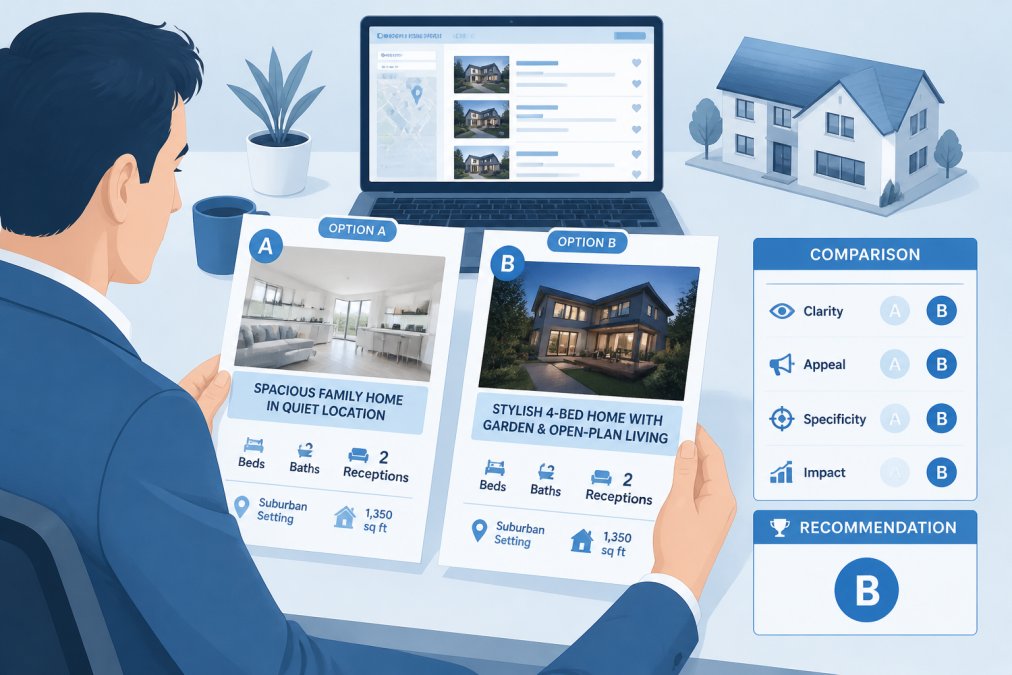
Adapt these property listing headline examples to your own stock:
- Two-bed flat with balcony, moments from the station
- Chain-free cottage with south-facing garden
- Renovated terrace with home office and parking
- Bright one-bed let, bills included, city centre
- Character pub with letting rooms and courtyard
Each one names the property, adds a real feature, and hints at a benefit. Rewrite your current headline using the formula and compare the two.
Holiday Rental Listing Title Tips for Bookings
Holiday lets need a slightly different approach, because guests book an experience, not just a property. Your title should sell the stay.
- Lead with the setting: "Coastal cottage with sea views"
- Name the group it suits: "Sleeps six, dog-friendly"
- Flag the draw: "Log burner, private hot tub, walk to beach"
- Keep it under 50 characters for the tightest platforms
- Back every claim with strong, honest photos of the space
Guests scan dozens of titles before tapping one. A clear, specific holiday rental listing title beats a poetic one every time. Pair it with professional imagery and you turn a browse into a booking enquiry.
That is where we come in. Property Home Photos works directly with photographer Mark Henry Rood to capture homes, holiday lets and venues at their best. We plan turnaround around your listing date, so your photos are ready when your headline goes live. Every shoot is punctual and calm, with a satisfaction guarantee behind it.
Frequently Asked Questions
What makes a property listing headline effective?
An effective headline names the property type, the strongest selling point and, where useful, the location, all within a few words. It should be specific rather than generic: 'Three-Bedroom Cottage with Sea Views' tells a buyer more than 'Beautiful Home'. It also needs to match what the photos and description actually show, because a headline that overpromises leads to disappointed viewings. Aim for clarity first, then add one persuasive detail that sets the property apart from similar listings.
How long should a property listing headline be?
Most property portals truncate headlines at around 60 to 70 characters, so front-load the most important words. Keep the core message within the first 50 characters where possible. On social media and email newsletters, shorter still works better because readers scan quickly on mobile. A practical rule is to write the headline, cut every word that does not add meaning, then check how it displays on each platform before the listing goes live.
Should property listing headlines include location or property features?
Include both when space allows, but lead with whichever matters more to your buyer. For sales listings, the property type and key feature often matter most, with the area added if it is a strong draw. For holiday rentals, location is usually the deciding factor, so put the town, coast or countryside setting early. If you must choose, prioritise the detail a buyer would search for, then support it with property listing headline examples from comparable listings in your area.
How can professional photography support a property listing?
A strong headline earns the click, but photos decide whether the enquiry follows. High-quality visuals, including a property video, show buyers and guests exactly what they are getting, which reduces wasted viewings and builds trust before the first contact. Pair each headline claim with an image that proves it: if the headline mentions sea views, the lead photo should show them. Professional photography also keeps listings consistent across portals, social media and email campaigns.
Your headline can only do so much. The click it earns lands on your photos, and that is where enquiries are won or lost. If your gallery looks credible, bright and true to the property, your headline's promise gets kept. Get started with Property Home Photos and give every listing the imagery it deserves. Request a quote today.