 how-to
What to Look For in a Property Photography Portfolio
Table of Contents
- Why Your Portfolio Choice Decides Whether Enquiries Convert
- Start With the Audience: Who the Portfolio Needs to Persuade
- Real Estate Photography Quality Standards to Check First
- Professional vs DIY Property Photography: What the Difference Looks Like
- The Shot Mix: Interior Photography, Exterior Shots and Detail Work
- Curation, Editing Style and Visual Storytelling
- Hiring a Professional Property Photographer: Red Flags and Green Lights
- Conversion Metrics, Mobile Viewing and Handling Critique
- Frequently Asked Questions
Last Updated: September 13, 2026
Why Your Portfolio Choice Decides Whether Enquiries Convert
A property listing lives or dies on its first image (rightmove.co.uk). According to Rightmove's guidance on listing photography, listings with strong lead images attract significantly more clicks than those with poor ones, and agents consistently report that image quality is the single biggest lever on enquiry volume. That is why knowing what to look for in a property photography portfolio matters more than most sellers realise. This guide from Property Home Photos breaks down the exact standards to check, the red flags to avoid, and how to judge a portfolio by whether it converts, not just whether it looks nice.
Here is the uncomfortable truth most guides skip: a portfolio is not an art gallery. It is a sales tool, judged on one question. Would this set of images make a buyer, tenant, or guest act?
Start With the Audience: Who the Portfolio Needs to Persuade
The first thing to establish is who the images are for. A property photography portfolio aimed at estate agents selling family homes needs a different emphasis from one built for holiday let owners chasing bookings or commercial landlords marketing office space.
But the more useful question is not who the audience is. It is how that audience behaves when they open your portfolio. Most guides treat this as a branding exercise. It is really a behavioural one.
What a Hiring Agent Actually Scans For
An agent is not studying your portfolio like a gallery curator. They are flicking through it between viewings, on a phone, deciding in seconds whether you are worth a call. What they subconsciously check:
- Speed of recognition, can they tell within two or three images what kind of property you shoot best?
- Reliability signals, do the images look like they were delivered on a deadline, or like they were salvaged from a rushed shoot?
- Risk reduction, does anything in the set suggest you might embarrass them in front of a vendor?
- Angle consistency, do you reliably find the shot that makes a room look its best, or is it hit and miss?
That last point matters more than most photographers realise. Agents are not buying 'nice photos'. They are buying a predictable outcome they can promise a vendor. A portfolio that shows the same considered approach to a cramped flat and a country house reads as reliable; one that only shines on easy properties reads as a gamble.
The Three Audiences and What Each One Doubts
Ask three questions before you judge any image:
- Who is the end viewer: a buyer, a tenant, a guest, or a commercial occupier?
- What decision are they trying to make, and what doubt is stopping them?
- Does this image remove that doubt or add to it?
A buyer viewing a family home doubts space and condition. A tenant doubts cleanliness and light. A guest booking a short let doubts whether the photos match reality. A commercial occupier doubts whether the space looks professional enough to put their name on. Each doubt needs a different kind of image, and a portfolio that answers only one is useful to only one kind of client.
A common mistake is judging a portfolio purely on how attractive the images are. Attractive is not persuasive. A wide, well-lit shot showing a room's true proportions will outperform a moody, tightly cropped image that hides how small the space is, the first removes doubt, the second creates it.
Real Estate Photography Quality Standards to Check First
The baseline for real estate photography quality standards is simple: sharp, correctly exposed, straight-walled images that represent the property honestly. If a portfolio fails on any of those, nothing else matters.
Resolution, Sharpness and Wide-Angle Composition
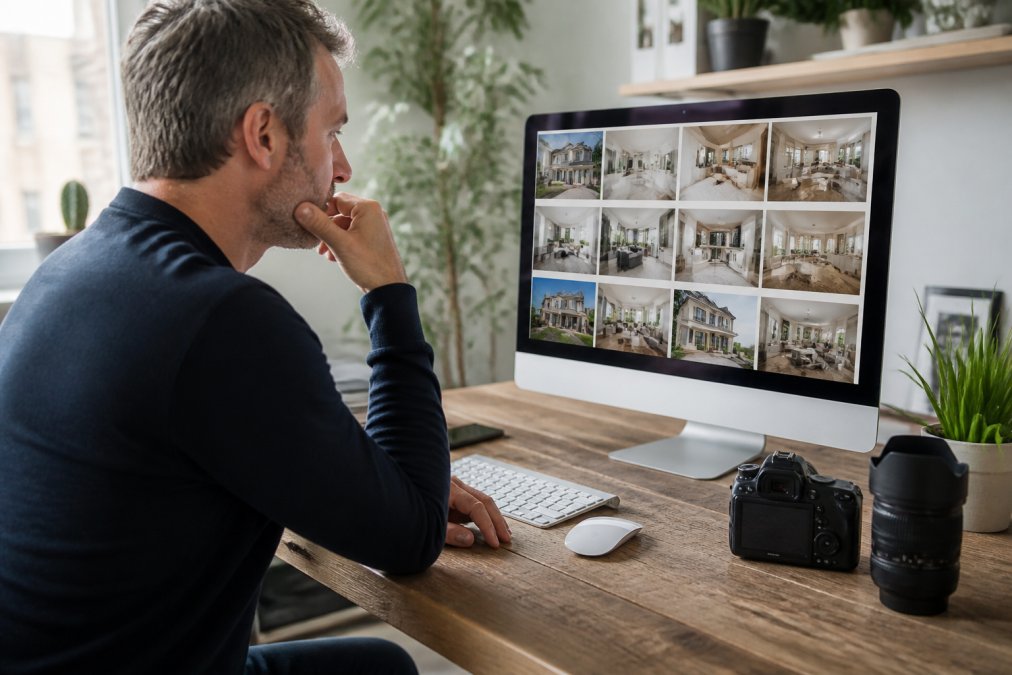
Check that images are high-resolution and sharp across the frame, not just the centre. Vertical lines should stay vertical: door frames, walls, and window edges should not lean. A wide-angle lens used well opens up a room without fish-eye distortion.
Lighting Conditions and Colour Grading Consistency
Good photographers handle difficult lighting rather than avoiding it. Look for windows not blown out to pure white, shadows that still hold detail, and colour grading that stays consistent from shot to shot. If one image is warm and golden while the next is cold and blue, the portfolio lacks a coherent editing style.
The most common portfolio flaw is inconsistent white balance between rooms. It signals a rushed edit, and buyers read it as a sign the property itself is inconsistent. If a photographer cannot keep colour grading steady across one property, they will not keep it steady across your listing.
Professional vs DIY Property Photography: What the Difference Looks Like
The gap between professional vs DIY property photography rarely shows up in a single hero shot. It shows up in the difficult rooms. A phone handles a bright, empty living room reasonably well, but struggles with a narrow hallway, a north-facing bedroom, or a bathroom with mixed lighting.
Here is what to compare side by side:
| Element | Typical DIY result | Professional standard |
|---|---|---|
| Straight verticals | Often leaning walls | Corrected in post |
| Window detail | Blown out to white | Balanced exposure |
| Colour grading | Auto, inconsistent | Consistent across set |
| Composition | Centred, flat | Considered angles |
| Detail work | Missed | Close-ups included |
A practical test: ask any photographer to show you their worst room, not their best. A portfolio of only easy, sunlit spaces tells you nothing about how they handle a challenging property.
The Shot Mix: Interior Photography, Exterior Shots and Detail Work
A complete portfolio shows range. Interior photography, exterior shots, and detail work should all appear, because a listing of only wide rooms leaves buyers guessing about the rest.
Check that a portfolio includes:
- Interior photography covering main living spaces, bedrooms, and bathrooms
- Exterior shots showing kerb appeal, garden, and approach
- Detail work such as fittings, finishes, and features that justify the asking price
- A listing video if the photographer offers one, since motion helps viewers understand flow between rooms
Room Shapes, Lighting Conditions and Staging Choices
The strongest portfolios show the photographer can adapt. An awkward L-shaped room, a long narrow kitchen, and a dark stairwell each demand a different approach. Look for staging decisions too: a tidy surface, a pulled-back curtain, a chair angled to add depth. These small choices are often the difference between a flat image and an inviting one.
Curation, Editing Style and Visual Storytelling
Curation is where a portfolio reveals its discipline. A photographer who shows forty images of one property is showing everything they shot, not their best work. The strongest portfolios are tightly edited.
Look for an editing style that stays consistent: the same colour grading, contrast, and approach to sky replacement or window pulls across every property. This consistency builds brand identity for an agent or developer, because buyers recognise the quality before they read the address.
Visual storytelling matters too. A well-curated set moves the viewer through the property logically: approach, entrance, main living space, kitchen, bedrooms, outdoor space, detail. If the sequence jumps around, it is a gallery, not a story.
Hiring a Professional Property Photographer: Red Flags and Green Lights
When hiring a professional property photographer, judge the portfolio against the property type you actually need shot. A portfolio of luxury country homes does not prove someone can make a compact city flat look spacious, and new-build show homes do not prove they can capture a busy pub or a working serviced accommodation unit.
Green lights to look for:
- A portfolio that matches your property type and business model
- Evidence of punctuality and clear turnaround commitments around your listing date
- A satisfaction guarantee or clear process for revisions
- A photographer who asks about your audience before they ask about your budget
Red flags to watch for:
- Only wide, empty rooms with no detail work
- Images that clearly misrepresent room sizes
- No consistent editing style across the portfolio
- Vague answers about turnaround or delivery
Conversion Metrics, Mobile Viewing and Handling Critique
Most buyers now see your listing on a phone first (statista.com). On a small screen, composition has to work at thumbnail size, the lead image has to earn the tap, and the gallery layout has to stay legible without pinching and zooming.
Mobile-First Checks You Can Run in Five Minutes
Judge a portfolio on mobile before desktop. If the images only work at full size, they will fail where most of your audience looks. Things to test:
- Load speed, open the gallery on a mobile connection, not office wi-fi. If images take more than a couple of seconds to appear, the portfolio is losing viewers before they see anything.
- Thumbnail legibility, shrink the gallery to the size it appears in a search result or a social feed. Can you still tell what each room is? If not, the composition is too busy.
- Touch targets, can you swipe between images without accidentally triggering a link or a pop-up? Fiddly galleries frustrate the exact people you want to convert.
- Lead image crop, check how the first image behaves in a square or portrait crop, because that is how it will often be displayed.
A portfolio that passes those four checks is already ahead of most of what is on the market.
How to Tell If a Portfolio Is Actually Converting
A portfolio's job is to move someone from browsing to enquiring: a strong lead image, a logical sequence, and a clear call to action in the surrounding listing. But you can only improve what you measure, and this is where most agents and photographers go quiet.
Practical ways to track whether a portfolio is working:
- Enquiry source, ask every enquirer where they first saw the property. Over a month, patterns emerge.
- Click-through on the lead image, if your listing platform reports views versus enquiries, a high view count with low enquiries usually points at the images, not the price.
- Heatmaps or scroll data, if your website or gallery tool offers them, check how far down the gallery people actually scroll. Most drop-off happens in the first few images.
- A/B the lead image, swap the first image on a live listing and compare enquiry volume over a comparable period. This is the single most useful test available, and almost nobody runs it.
Many agents track clicks and enquiries but never connect them to image quality. Compare enquiry rates on listings shot well against those shot poorly, the pattern is usually obvious.
Handling Critique Without Losing the Plot
Finally, expect critique. Buyers, guests, and even the property owner will have opinions, some blunt. Treat feedback as data, not insult. If guests repeatedly say a listing did not match reality, the problem is usually the images, not the property.
A simple iteration loop keeps a portfolio sharp:
- Collect feedback from the last five listings you shot.
- Group it into themes, lighting, composition, accuracy, turnaround.
- Change one thing at a time and watch whether enquiries move.
- Retire the images that consistently attract the wrong kind of attention.
Do not treat a portfolio as finished. The strongest portfolios are revised every few months as property types, platforms, and viewer behaviour shift. A portfolio that has not changed in two years is usually a portfolio that has stopped learning.
The test is not whether a portfolio looks good on your desktop. It is whether it loads fast, reads clearly, and drives an enquiry on a phone, in seconds, and whether you are measuring that, not guessing.
Frequently Asked Questions
What should a property photography portfolio include to demonstrate professional quality?
A strong portfolio shows a complete shot mix: wide-angle interior photography, exterior shots, and close-up detail work such as fixtures and finishes. Look for consistent lighting across every image, straight vertical lines, and a coherent editing style rather than a patchwork of filters. It should also reflect the property types you deal with, whether new homes, serviced accommodation or commercial property. If a portfolio only shows one or two room types, ask to see a full gallery from a recent shoot before you commit.
How do I tell the difference between professional vs DIY property photography?
DIY images usually show tilted verticals, mixed colour temperatures between rooms, and blown-out windows. Professional property photography keeps verticals straight, balances interior and exterior exposure, and applies one consistent editing style across the whole set. Resolution also matters: professional files are delivered at high resolution, suitable for print and portal listings, while phone photos often fall apart when enlarged. Compare the same room type side by side and the gap becomes obvious quickly.
What are the red flags when hiring a professional property photographer?
Watch for portfolios with no full galleries, only heavily filtered hero shots, or images that clearly come from other photographers. Ask how turnaround works around your listing date and what happens if you are not happy with the results. A photographer who cannot explain their editing style, or who will not share recent work in your property category, is a risk. Clear communication about delivery times and a satisfaction guarantee are good signs.
Should a property photography portfolio include listing video as well as stills?
Yes, where the property or venue suits it. Listing video helps viewers understand layout and flow in a way stills cannot, and it works well for holiday lets, hospitality venues and larger commercial spaces. Check that any video in the portfolio is short, well-paced and shot in the same visual style as the stills, so your brand identity stays consistent across every channel. If video is not offered, ask whether it can be arranged.