 how-to
Real Estate Photography Turnaround Times: 2026 Guide
Table of Contents
- What Counts as a Typical Real Estate Photography Turnaround Time?
- Estate Agent Expectations for Listing Photography: What Buyers and Sellers Actually Need
- Factors Affecting Real Estate Photo Editing Time, From File Size to Batch Size
- Next-Day vs 48-Hour Delivery: Which Model Fits Your Listing Date?
- Balancing Speed and Quality in Property Marketing
- How Turnaround Differs by Service Type: Photos, Video and Floor Plans
- Pricing for Speed: Rush Service, SLAs and Setting Client Expectations
- Frequently Asked Questions
Last Updated: September 17, 2026
What Counts as a Typical Real Estate Photography Turnaround Time?
Real estate photography turnaround times describe the gap between the photographer packing up on site and the finished gallery landing in your inbox. For most professional shoots, that window runs from 24 to 72 hours. Same-day delivery exists, but it is the exception, not the standard.
At Property Home Photos, we plan turnaround around your listing date rather than around a fixed template.
So what actually happens in that window? Editing is only part of it. File transfer, colour correction, HDR processing, quality control and gallery upload all take time. Understanding each stage is how you avoid the Thursday-morning panic that catches out so many agents.
Below, we break down what drives delivery speed, where the real bottlenecks hide, and how to set expectations with sellers before the shoot even happens.
Estate Agent Expectations for Listing Photography: What Buyers and Sellers Actually Need
Most sellers assume photos appear within a day or two. Most buyers, meanwhile, decide whether to book a viewing in the first few seconds of scrolling. Those two facts pull in opposite directions, and estate agent expectations for listing photography sit right in the middle.
The practical answer is that a listing rarely needs photos in hours. It needs them before the portal window opens. If your property goes live on Thursday, a Wednesday evening delivery is perfect. A Tuesday delivery is early. A Friday delivery is a missed opportunity.
What most guides miss is that sellers care about certainty, not raw speed. A vendor told "within 48 hours" and delivered in 40 is happier than one told "next day" and delivered in 30. Under-promise, then beat it.
- Sellers want: a clear date and time, no chasing, images that match the property
- Buyers want: accurate, well-lit photos that answer layout questions fast
- Agents want: assets ready before the portal listing goes live
Factors Affecting Real Estate Photo Editing Time, From File Size to Batch Size
Editing time scales with three things: how many images you shot, how complex each one is, and how large the files are. A ten-photo flat in good light is a quick job. A forty-shot period property with mixed lighting is not.
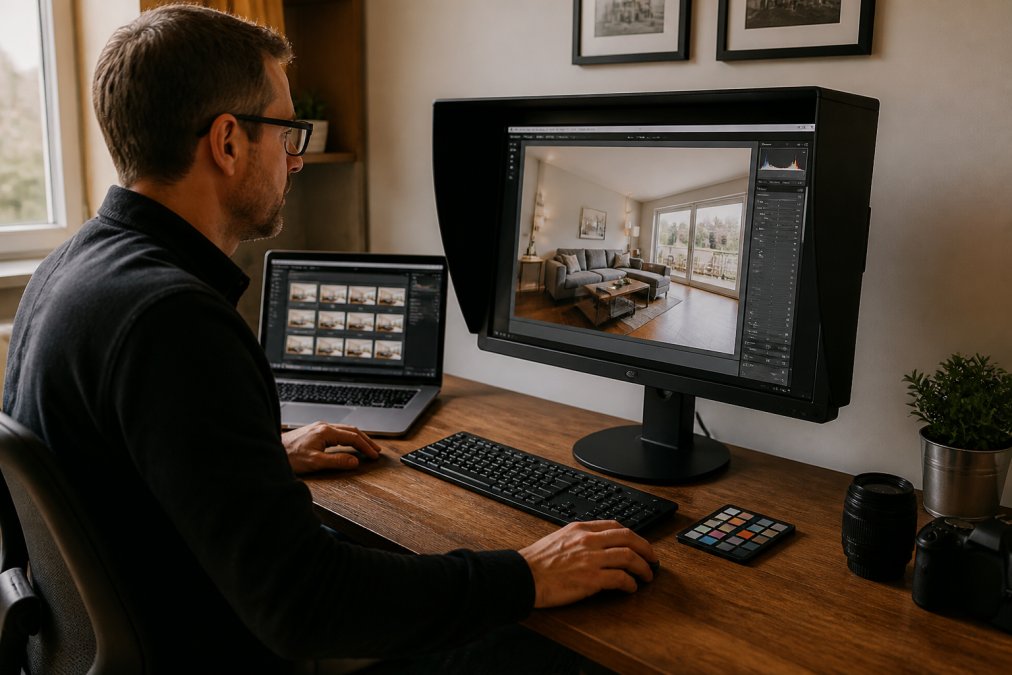
Batch size matters more than most people realise. When a photographer processes one property at a time, they can deliver fast. When ten shoots land on the same day, each one waits its turn. That is not laziness; it is capacity.
The factors that slow things down most often:
- HDR processing on rooms with bright windows and dark corners
- Virtual staging requests, which add a separate workflow
- Large RAW files from full-frame cameras, which take longer to transfer and render
- Revisions after delivery, which restart the clock
Technical Bottlenecks Beyond Editing: Upload Speeds, Bandwidth and File Transfer
The editing suite is rarely the slowest part of the chain. Upload speed usually is.
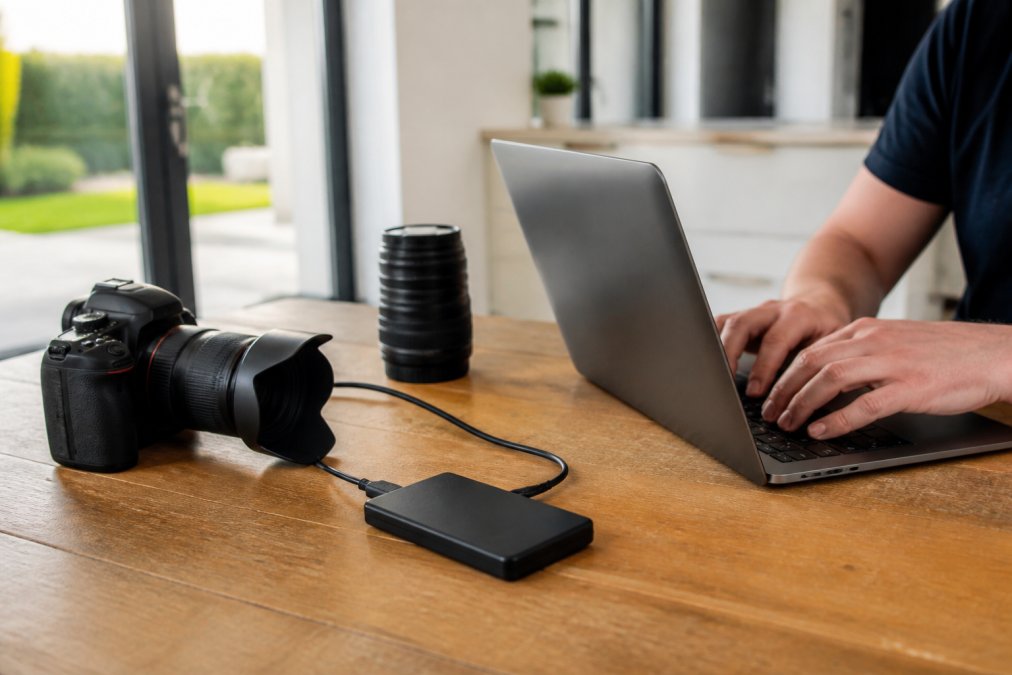
A full property shoot can run to several gigabytes of RAW files. On a standard domestic connection, pushing that to cloud storage can take longer than the edit itself. Photographers working from rural locations or older premises feel this most.
This is why file transfer method matters.
Next-Day vs 48-Hour Delivery: Which Model Fits Your Listing Date?
Next-day delivery suits properties where the market moves fast: new instructions, competitive price brackets, or anything launching alongside a portal promotion. The trade-off is cost and scheduling flexibility, since the photographer has to prioritise your job.
| Delivery Model | Typical Window | Best For | Trade-off |
|---|---|---|---|
| Same-day | Under 12 hours | Urgent relaunches | Highest cost, limited slots |
| Next-day | 24 hours | Fast-moving listings | Premium rate, tighter scheduling |
| 48-hour | 2 working days | Most standard listings | None for typical timelines |
| Standard | 3-5 working days | Portfolios, bulk shoots | Too slow for live listings |
Balancing Speed and Quality in Property Marketing
Speed and quality are not opposites, but they do compete for the same hours. Balancing speed and quality in property marketing comes down to knowing which parts of the process can be compressed and which cannot, and, crucially, which parts you can hand off to software so a human never touches them.
- Capture (linear): every extra frame adds shooting and culling time. A 25-image package takes longer than a 15-image one, full stop.
- Ingest and transfer (linear): file size and connection speed set a hard floor. A 4GB RAW set on a 10Mbps upload link takes roughly an hour before any editing begins.
- Culling and selection (semi-linear): doubling the shot count roughly doubles the time spent choosing keepers.
- Colour correction and exposure blending (non-linear): a well-exposed bracket set can be batch-processed; a badly exposed one needs per-image work.
- Quality control (fixed): the same checklist applies whether you shot 15 images or 45.
How Turnaround Differs by Service Type: Photos, Video and Floor Plans
Photos are the fastest asset to deliver. Video takes longer because it involves cutting, colour grading, music, and often client review. Floor plans sit in between, since they depend on accurate measurements and drafting. But the why behind those windows matters more than the windows themselves, and it is where most guides stop short.
- Listing photos: typically 24-48 hours after the shoot. The window is driven by culling, bracketed exposure blending, and QC, all of which scale with image count.
- Floor plans: usually 2-3 working days, longer if measurements need checking. The bottleneck is drafting accuracy, not editing speed; a plan that does not match the property is worse than no plan.
- Promotional video: commonly 3-7 working days, depending on length and revisions. Video adds a review cycle that photos do not, the client watches, comments, and the editor re-cuts.
- Virtual staging: adds 1-2 days on top of standard photo delivery, because it runs as a separate workflow with its own QC pass.
How batch size changes the maths
A single property delivered alone can hit next-day comfortably. Ten properties landing on the same Monday cannot all be next-day, no matter how fast the editor is, the work is linear and the hours are finite. This is the single biggest reason agents get surprised by turnaround during a busy instruction week.
Tiered pricing for speed
Speed is a premium service, and it should be priced like one. A common structure looks like this:
- Standard (3-5 working days): the base rate. Fits portfolios, bulk shoots, and anything not tied to a live portal date.
- Priority (48 hours): a modest uplift. The photographer batches your job ahead of standard work.
- Rush (next-day): a larger uplift, because it means dropping or rescheduling other clients' work.
- Same-day (under 12 hours): the highest tier, with limited slots. Usually reserved for relaunches or price-drop pushes where the listing is already live.
Pricing for Speed: Rush Service, SLAs and Setting Client Expectations
Rush service is a premium, and it should be. A photographer who drops other work to prioritise your shoot is absorbing a real cost, and pricing for speed reflects that.
When setting client expectations, be specific:
- State the delivery window in hours, not vague terms
- Confirm what counts as delivery (gallery link sent, not edit finished)
- Agree in advance how revisions are handled and how they affect timing
- Flag peak season early, when demand stretches every photographer's capacity
Planning turnaround before the shoot can help avoid delays.
Frequently Asked Questions
What is a reasonable turnaround time for a property photographer?
For most residential listings, 24 to 48 hours from shoot to delivery gallery is a reasonable window. A simple two-bedroom flat with standard image editing can often be returned next day, while larger properties with video production, floor plans or virtual staging take longer. If your listing goes live on a set date, confirm the turnaround time in writing before booking so the schedule is built around your deadline rather than squeezed in afterwards.
Does a faster turnaround time impact the quality of property photography?
It can, if speed comes from cutting quality control. Colour correction, HDR processing and metadata checks all take time, and rushing them shows in uneven exposures or inaccurate room tones. The better approach is to speed up the parts clients never see, such as batch processing and file transfer, while protecting the editing and quality control stages. A photographer who plans turnaround around your listing date can usually deliver quickly without lowering standards.
How long should estate agents expect to wait for listing photos?
Estate agent expectations for listing photography usually sit at 24 to 72 hours, depending on the property and the package booked. Standard photo-only shoots are typically delivered within a day or two, while video production, floor plans and virtual staging add time. During peak season, such as spring and early autumn, delivery windows can stretch, so book the shoot earlier than you think you need it and confirm the delivery date in the service level agreement.
What factors influence the delivery time of professional property photos?
The main factors are the number of images shot, the amount of post-processing each one needs, upload speed and bandwidth at both ends, file size, and whether video, floor plans or virtual staging are included. Batch size matters too: a single listing moves through editing faster than a block of ten shot on the same day. Weather and access delays on site can also push the whole schedule back, which is why buffer time before launch is worth building in.