 how-to
Choosing the Right Music for Property Cinematic Films
Table of Contents
- Why Music Makes or Breaks a Property Cinematic Film
- What Viewers Hear Before They See
- Step 1: Match the Music to the Property's Story and Audience
- Step 2: Build Property Video Music Ideas Around Mood and Genre
- Step 3: Use Music Pacing for Cinematic Property Films
- Step 4: Source Royalty-Free Music for Property Videos
- Step 5: Get Music Licensing for Property Videos Right
- Step 6: Test the Track Against the Finished Edit
- Conclusion
- Frequently Asked Questions
Last Updated: October 19, 2026
Why Music Makes or Breaks a Property Cinematic Film
Music is the fastest way to change how a viewer feels about property cinematic films.
The visuals show the space, but the music decides the mood. A bright, spacious kitchen can feel clinical with the wrong track, and warm and inviting with an acoustic guitar underneath it.
Music feels like a small decision. It isn't. It shapes watch time, completion rate and how long a viewer stays engaged with a property listing.
What Viewers Hear Before They See
Viewers form a first impression of a property film in the opening seconds, and sound does most of that work. The music sets tone before the first room appears, telling the viewer what kind of property this is and what kind of buyer it suits. Music selection deserves the same care as the photography: a luxury apartment and a family home should never share the same soundtrack.
Step 1: Match the Music to the Property's Story and Audience
Start with the story, not the song. Ask three questions before you open a music library:
- Who is this property for? A first-time buyer, a holiday let guest, or a commercial tenant?
- What feeling should they leave with? Calm, excitement, aspiration or confidence?
- What is the one thing this property does best? Light, space, location or finish?
A family home in a quiet area wants warm, gentle music; a city-centre apartment wants more energy; a hospitality venue wants atmosphere. Build the story first, then find the music that carries it, the same track that works for a holiday let can feel wrong for an office space.
Step 2: Build Property Video Music Ideas Around Mood and Genre
Once you know the story, translate it into mood and genre. Mood is the feeling, genre is the style that delivers it. Get both right and the track sits naturally under the visuals.
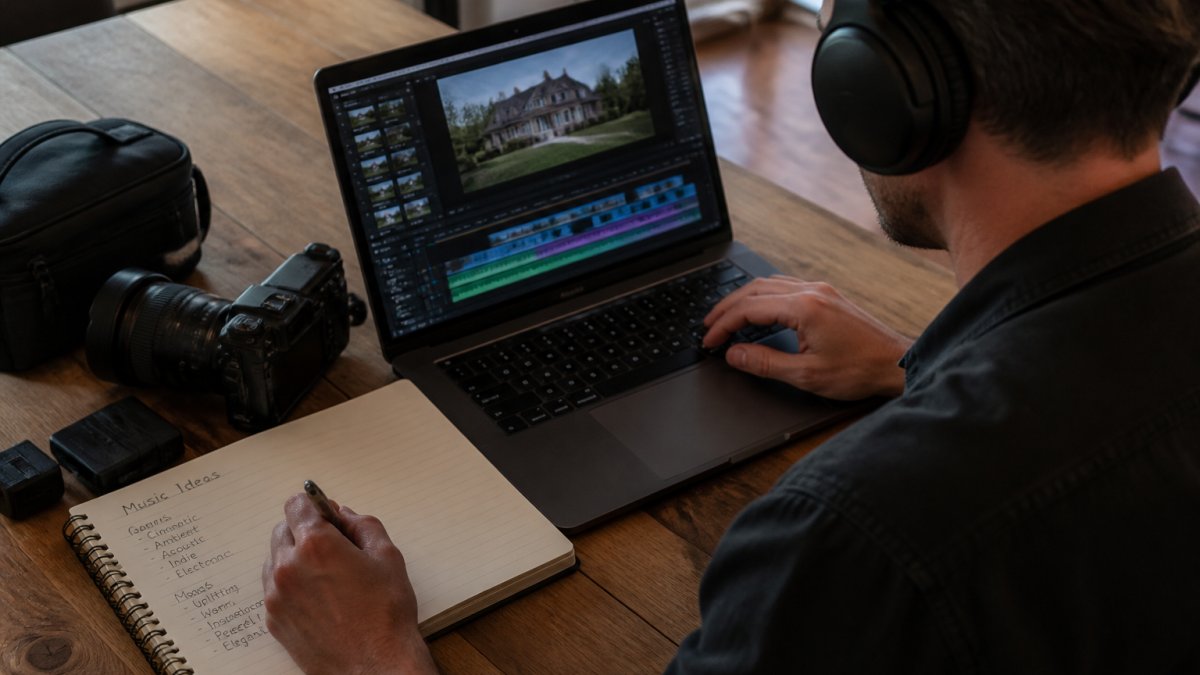
A practical way to build property video music ideas is to shortlist three tracks per mood, not one, then test them against the edit. This stops you settling for the first track that fits the runtime.
Acoustic, Electronic or Funk: What Suits Which Space
- Acoustic music: warm and human. Best for family homes, cottages and holiday lets.
- Electronic music: clean and modern. Best for city apartments, new builds and commercial spaces.
- Funk: upbeat and confident. Best for hospitality venues, bars and social spaces.
Pick the style that matches the space, then refine the tempo and energy to fit the pacing.
Step 3: Use Music Pacing for Cinematic Property Films
Music pacing for cinematic property films should follow the edit, not fight it. Slow, steady tracks suit sweeping room reveals; faster tracks suit quick cuts and energetic montages. Match the rhythm of the track to your transitions, a cut on the beat feels intentional, a cut against it feels accidental.
Step 4: Source Royalty-Free Music for Property Videos
Royalty-free music for property videos is the safest route for most listings, but 'royalty-free' is a pricing model, not a permission. It means you pay once (or via a subscription) and can use the track repeatedly under the licence terms, not that it is free of rules or cleared for every platform or commercial use. For a property film appearing on a portal listing, website, Instagram, TikTok and possibly a paid Meta or Google ad, you need a licence that explicitly covers commercial use, paid promotion and social-media uploads.
A practical sourcing workflow
- Define the usage scope first. Write down every place the film will appear, portal listing, agency website, YouTube, Instagram Reels, TikTok, paid social, email, brochure QR link, and the campaign duration. This determines which licence tier you need.
- Filter the library by licence, not just mood. Most libraries let you filter by 'commercial', 'social media', 'paid ads' and 'broadcast'. Apply those filters before you audition tracks so you do not fall for a track you cannot legally use.
- Check the term and territory. Confirm the licence covers the UK and the period you need. Some subscription licences require the subscription to remain active for the content to stay live; others grant a perpetual licence for content published during the term.
- Check the track's provenance. Prefer libraries that provide a written warranty that the track is cleared for your uses and that the composer has signed the relevant rights, this matters if a platform later challenges the audio.
- Download the licence certificate at the point of download. Save the PDF or email confirmation alongside the project file, with the track title, composer, licence ID, date and the usage scope you selected.
UK-relevant licence and platform considerations
- Synchronisation rights. Putting music under a property film is a synchronisation use, pairing music with moving images (Synchronise and commercialise). A royalty-free library licence is effectively a pre-cleared synchronisation licence for the uses it names. If you commission bespoke music, the composer agreement should assign or license the synchronisation right explicitly, in writing.
- Platform rules. YouTube's Content ID and Meta's rights-management systems can flag audio even when you hold a valid licence. A licence certificate is your evidence in a dispute. Keep it accessible, not buried in an old inbox.
- Paid ads. A track cleared for organic social is not automatically cleared for paid promotion. Check the licence tier for 'paid social' or 'advertising' before you boost a property film.
When royalty-free is not the right answer
For a flagship development or a brand film with a long shelf life, a bespoke or premium-licensed track can be worth the cost because it is unique to the property and carries clearer, broader rights. For most listing films, a well-chosen royalty-free track with a commercial licence is the pragmatic choice, provided you keep the proof.
Step 5: Get Music Licensing for Property Videos Right
Music licensing for property videos is where many agents and developers come unstuck, because a property film is a commercial marketing asset and most casual music use is not licensed for that purpose. Getting it wrong can mean a muted video, a takedown, a platform strike or a legal claim, and a dead listing link on launch day.
The two rights you are actually clearing
Using a piece of recorded music in a film involves two separate rights:
- The composition (publishing) right, owned by the songwriter or publisher. Using it in a film is a synchronisation use.
- The recording (master) right, owned by the record label or artist. Using the specific recording is a master use.
A chart track from a streaming service clears neither for commercial use. A royalty-free library licence typically pre-clears both for the uses named in the licence, which is why it is the practical route for property marketing. If you commission bespoke music, your composer agreement should cover both rights in writing.
Matching the licence to the channel
| Channel | What to check |
|---|---|
| Portal listing and agency website | Commercial use permitted; territory includes the UK; term covers the listing period |
| Organic social (Instagram, TikTok, YouTube) | Social-media use permitted; platform-specific restrictions noted |
| Paid social and display ads | 'Paid promotion' or 'advertising' tier included |
| Email and brochure QR links | Digital marketing use permitted |
| Broadcast or cinema | Usually excluded from standard library licences, check separately |
If a single track cannot cover every channel, either upgrade the licence tier or use different tracks for different placements. Do not assume one download covers everything.
Keeping proof of licence
Platforms and clients may ask for evidence months or years after publication. For every track used, keep the licence certificate or receipt (track title, composer, licence ID, date), the usage scope selected at checkout (commercial, social, paid ads, term, territory), and a note of where and when the film was published. Store these with the project files and pass a copy to the client on delivery, if a platform flags the audio, this record is your first line of defence.
A note on 'free' music
Free tracks from libraries that require attribution can be legitimate, but the attribution obligation is a licence condition, strip it out or forget it and you are in breach. For client-facing property marketing, a paid commercial licence with no attribution requirement is usually simpler and safer, because the agent can republish the film without a credit line.
When to involve a specialist
For a large development, a TV or cinema campaign, or a film that will run for years across many channels, it is worth taking advice on the licence terms before you commit. For routine listing films, a commercial royalty-free licence plus a licence log covers the vast majority of use cases.
Step 6: Test the Track Against the Finished Edit
The final step is the one most people skip: listen to the music against the finished edit. Play the whole film with the sound on, then again with the sound off. Both versions have to work.
Listening for Silence, Dialogue and Sound-Off Viewing
Many viewers watch property films with the sound off, especially on social media, so the visuals must carry the story alone. If the film only makes sense with music, it needs better pacing and clearer shots.
Run this final checklist before you publish:
- Music matches the property's story and audience
- Tempo and energy fit the pacing of the edit
- Licence covers commercial use and every platform you'll use
Conclusion
Choosing the right music for property cinematic films comes down to one idea: the soundtrack should sell the same story the visuals tell.
You work directly with photographer Mark Henry Rood, with a satisfaction guarantee and turnaround planned around your listing dates.
Ready to give your listing a film that sounds as good as it looks? Request a quote from Property Home Photos and get visuals that help your property win enquiries.
Frequently Asked Questions
Can you use copyrighted music in a property video?
No, not without a licence that covers commercial use. Chart tracks and film scores are protected by copyright, and a property listing counts as commercial promotion. Using them without permission risks takedowns, muted audio, or claims against the agent or developer. Stick to royalty-free music for property videos where the licence explicitly allows marketing and advertising use, and keep the licence certificate on file in case a platform asks for proof.
What does royalty-free music mean for a property film?
Royalty-free means you pay once for the track and can keep using it without paying the composer each time it plays. It does not mean free of charge, and it does not mean free of rules. Check the licence terms for commercial use, platform limits, and whether you can use the track across multiple listings. A track cleared for one property film may not be cleared for a paid social campaign, so read the terms before you export.
How long should a property video soundtrack be?
Match the track to the final runtime, not the other way around. A typical cinematic property film runs 60 to 90 seconds, so choose a track with a clear structure you can cut to: an opening, a build, and a settled ending. If the track is longer than the edit, trim at a natural break rather than fading mid-phrase. If it is shorter, loop a section that does not draw attention to the join.
How do you match music to a property's style and audience?
Start with who is buying or renting and what the property promises. A family home near good schools suits warm acoustic guitar and a steady mid-tempo. A city-centre apartment aimed at young professionals suits restrained electronic music with a clean beat. A period cottage needs strings or piano that support the character without overwhelming it. Play two or three options against the same edit, then pick the one that makes the space feel most like the listing description.